



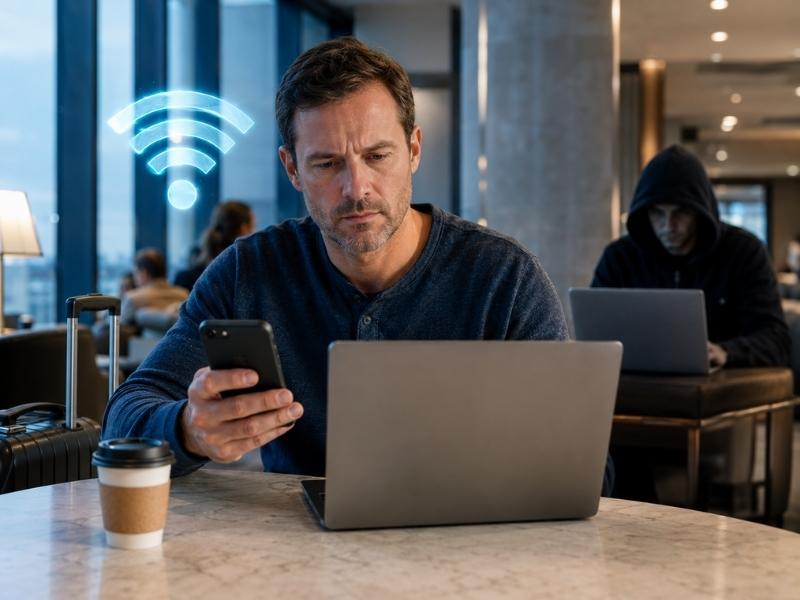
- Public Wi-Fi at airports, hotels and cafés can expose your accounts if you connect without protection.
- Fake Wi-Fi networks can trick travelers into handing over passwords, session data and personal information.
- A trusted VPN encrypts your internet traffic so snoops on the same network cannot easily read it.
- A few simple habits, like checking network names and turning off auto-connect, can make travel browsing safer.
You step off a long flight, find your hotel, and the first thing you look for is the Wi-Fi password. You connect, clear your inbox, log into your streaming account to unwind and maybe check your bank balance before dinner. It all feels harmless because we all do it.
But that one travel habit can quietly put your passwords, accounts and personal information at risk.
Public Wi-Fi is convenient for you. It can also be convenient for the person sitting three tables over with a laptop and bad intentions.

Why public Wi-Fi is such a soft target
Most public networks send your data through the air on a network you do not control. When a network is open, anyone connected to it may be able to use simple tools to watch traffic patterns, spot unencrypted activity or try to redirect you to fake login pages. Security researchers call this packet sniffing. Modern HTTPS protects most usernames and passwords, but not every app, site or connection handles security perfectly. That is where public Wi-Fi can still get risky fast.
Then there are the fake networks. A hacker sets up a hotspot named something friendly like “Airport_Free_Wi-Fi” or “Hotel Guest,” and travelers connect without a second thought. Once you’re on their network, everything you do passes through their hands first. This trick is common enough that it has a name: the evil twin attack.
Here’s the part most people miss. Stealing your password is not the only goal. When you log into a service, your device gets a small file called a session token that keeps you signed in. If an attacker can trick you onto a fake network, push you toward a fake login page or exploit a poorly protected connection, that token or login can become a target. That is how a quick hotel Wi-Fi session can turn into someone hijacking an account, locking you out, racking up charges or selling your access on the side.
Your phone, your laptop, your email, your banking app, your streaming logins. On an unprotected network, all of it is fair game.

The simple fix: encrypt everything you send
The good news is that protecting yourself does not require you to become a security expert or swear off public Wi-Fi forever. You just need a Virtual Private Network, or VPN.
A VPN builds an encrypted tunnel between your device and the internet. Everything you send and receive gets scrambled before it leaves your phone or laptop, so even if someone is watching the network, all they see is meaningless noise. Your passwords, your messages, your account logins and your banking details stay locked up tight.
The catch with a lot of VPNs is that people either forget to turn them on or find them clunky enough to give up. The best VPN for travel should be easy to use, fast enough for streaming and video calls, strong on privacy and able to protect your devices with one tap. My No. 1 pick is ExpressVPN because it checks those boxes without making you think about it. It uses strong encryption, has a no-logs policy, includes a kill switch if the VPN connection drops and runs on iPhone, Android, Windows, Mac and routers.
ExpressVPN – Best for Speed & Security
ExpressVPN is the go-to choice for those who prioritize ultra-fast speeds, reliability, and top-tier security. With servers in 105 countries, ExpressVPN delivers blazing-fast performance for streaming, gaming, and secure browsing. It supports P2P file sharing, offers best-in-class encryption, and maintains a strict no-logs policy, with all servers running on RAM for enhanced privacy. You can connect up to 10 devices simultaneously, and setup takes under 2 minutes. Plus, with 24/7 live customer support and a 30-day money-back guarantee, ExpressVPN is a premium choice for security-focused users who want speed without compromise.
CyberGuy Exclusive ExpressVPN “Pro” Deals:
✅ Save 75% – Get 3 months FREE with 12-month plan for $3.99/month. Try 30 days risk-free.
✅ Save 84% – Get 4 months FREE with 24-month plan for $2.49/month. Try 30 days risk-free.

A few smart habits to pair with it
A VPN does the bulk of the work, but these quick moves close the remaining gaps.
1) Turn off auto-connect
Stop your phone from automatically joining Wi-Fi networks you do not fully trust.
On iPhone: go to Settings > Wi-Fi > Ask to Join Networks and choose Ask or Notify. You can also tap the info icon next to a saved network and turn off Auto-Join.
On Samsung: go to Settings > Connections > Wi-Fi, tap the gear icon next to a saved network and turn off Auto reconnect.
2) Confirm the network name before you connect
Before joining a hotel, airport or café Wi-Fi, ask the staff for the exact network name. Fake “free Wi-Fi” networks often use names that look official enough to fool tired travelers.
3) Turn on two-factor authentication
Even if a password leaks, 2FA gives an attacker another wall to get past before they can break into your account.
4) Use a password manager
Better still, use a password manager to create and store super-secure credentials that are unique for every site. In fact, my favorite VPN, ExpressVPN, bundles its ExpressKeys password manager with Advanced and Pro subscriptions.
5) Save the sensitive stuff for trusted connections
When you can, handle banking, shopping and other sensitive logins on cellular data, your phone’s hotspot, your home network or a trusted VPN.
Related Links:
- Why your VPN keeps getting blocked and the simple fix
- Can you be tracked when using a VPN?
- Tired of websites blocking your VPN? A dedicated IP fixes that
Kurt’s key takeaways
The trip is supposed to be the memorable part, not the security headache you deal with after you get home. The travel mistake is treating free Wi-Fi as safe Wi-Fi. Free Wi-Fi can be risky, and the people who exploit it are counting on you not to notice. Flip the script with a trusted VPN, build the one-tap habit, and you close one of the easiest doors hackers use against travelers.
Do you turn on a VPN the moment you connect to public Wi-Fi, or only when you remember? Let me know in the comments below.
FOR MORE OF MY TECH TIPS & SECURITY ALERTS, SUBSCRIBE TO MY FREE CYBERGUY REPORT NEWSLETTER HERE
This article was created in partnership with ExpressVPN
Copyright 2026 CyberGuy.com. All rights reserved. CyberGuy.com articles and content may contain affiliate links that earn a commission when purchases are made.