



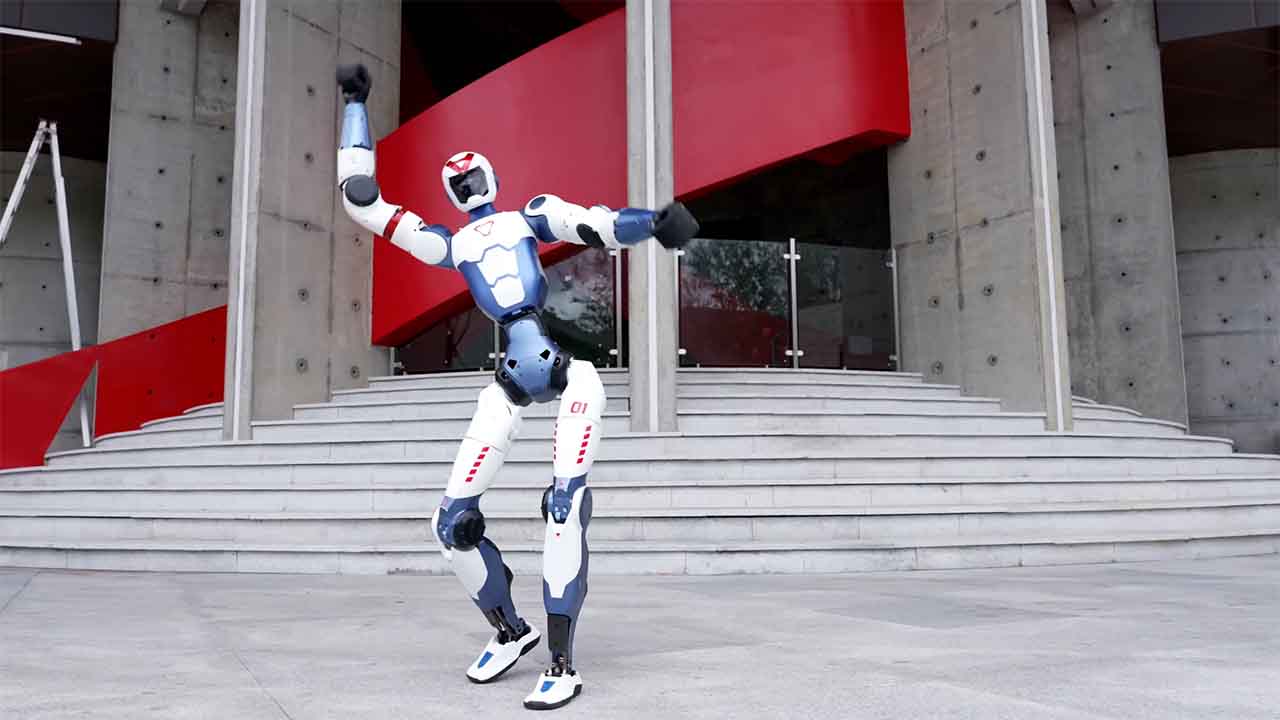
Unitree just dropped its latest creation, the R1 humanoid robot, and people are talking. At only $5,900, it’s the most affordable bipedal robot we’ve seen so far.
The low price has taken the tech world by surprise and kicked off a wave of excitement. It’s a big step toward making humanoid robots more affordable for people.
Credit: Unitree
Unitree R1 shows off robot agility in promo videos
In Unitree’s promo videos, the R1 shows off by running, spinning, shadowboxing, doing handstands, and even nailing cartwheels. People are starting to realize just how far these humanoid robots have come in terms of coordination and agility. What’s especially wild is that it’s not priced exclusively for big research labs; regular consumers might actually be able to get their hands on one.

Credit: Unitree
Unitree R1 features: Flexibility, sensors, and EDU upgrade
The robot can pull off impressive moves thanks to 26 joint degrees of freedom, giving it flexibility similar to a gymnast. It uses onboard sensors, like binocular and wide-angle cameras, microphones, and speakers to understand and navigate its surroundings. An 8-core CPU and GPU power tasks such as voice and image recognition. Its battery lasts about one hour per charge, which is solid for a robot this size.
Speaking of size, the R1 weighs around 55 pounds and stands about 4 feet tall. That makes it compact enough to fit easily into classrooms or labs. The standard model comes with fixed open fists, so it can’t actually grip objects. However, an advanced EDU version offers movable fingers and lets each arm carry up to 6.6 pounds.

Credit: Unitree
How the Unitree R1 breaks the price barrier in humanoid robotics
Unitree’s older models include the G1 at sixteen thousand dollars and the H1 at over ninety thousand. In comparison, the R1 feels like a total game changer. Its lower price gives researchers, small developers, and educators a new opportunity to explore humanoid robotics.
Of course, some people are a little skeptical. A few have raised questions about whether the promo footage uses CGI or overly scripted setups. And let’s be honest, anyone who’s seen robots go off script knows how unpredictable things can get. That’s why solid software and strong safety systems are still so important, especially at this price point.

Credit: Unitree
How the Unitree R1 could advance robotics research and healthcare
Administrators and researchers around the world are closely watching Unitree’s move. China’s strength in manufacturing and low-cost hardware gives it a clear advantage, especially as it goes head-to-head with U.S. players like Tesla, Figure AI, and Agility Robotics. Everyone’s racing to make humanoids affordable and practical.
Watch the latest episode of The CyberGuy Report.

Missed this event? Sign up via the registration form and see our live recording.
See Kurt’s latest Amazon picks for useful gadgets, smart home upgrades and everyday tech worth grabbing while the deals last.
Some researchers are already working the R1 into academic projects. Researchers expect machine learning systems and training tools from older models to work with the R1 as well. And in the medical world, some trials are exploring how humanoid robots can assist in remote care, though they still need improvements in strength and sensitivity.

Credit: Unitree
What this means for you
If you’ve ever dreamed of working with a humanoid robot but thought it was out of reach, the R1 changes that. At $5,900, it’s affordable enough for educators, researchers, and developers on a budget.
It can walk, spin, and even cartwheel, giving you a real platform to test AI and robotics projects. The standard version doesn’t grip, but the EDU model adds movable fingers and more power.
With its compact size and one-hour battery life, the R1 fits easily into classrooms, labs, or maker spaces. It’s not perfect, but it’s a big step toward making humanoid robotics truly accessible.
Related Links
Kurt’s key takeaways
The Unitree R1 is catching attention for all the right reasons. It’s fast, flexible, and surprisingly affordable, just $5,900 for a bipedal humanoid that can run, cartwheel, and react to its surroundings. That’s huge for schools, researchers, and developers who’ve never had access to this kind of tech at this kind of price. But while it looks impressive on video, some folks are wondering how it performs in real life. Is it a reliable research tool or just a flashy demo machine? One thing’s clear: the R1 could mark a turning point in the push to bring humanoid robots into everyday life. Could robots like this really end up in classrooms, clinics, or even homes someday?
If humanoid robots become affordable, how comfortable would you be sharing your space with one? Let us know in the comments below.
FOR MORE OF MY TECH TIPS & SECURITY ALERTS, SUBSCRIBE TO MY FREE CYBERGUY REPORT NEWSLETTER HERE
Copyright 2025 CyberGuy.com. All rights reserved. CyberGuy.com articles and content may contain affiliate links that earn a commission when purchases are made.
🎙 Now Streaming: My New Podcast: The CyberGuy Report
Kurt’s Top Deals
Deals move fast and inventory can be limited, so don’t wait too long.
| 🔥 Editor’s pick  Summer entertaining Ninja SLUSHi Machine (26% off) Frozen drinks and slushies at home in minutes. | |
| 💰 Top deal  Outdoor essential TYPEC Solar Bug Zapper (36% off) Solar-powered bug zappers for patios and camping. |


3 comments
Hopefully they will come up with a handyman robot–I’ll go for it.
I am 73 years old and am more than ready for an affordable and usable humanoid in a home environment. While a version of it that does flips represents great dexterity, I have no interest in one that can do flips. Nor would I want to pay for that ability. A version that can reliably autonomously move about in my home is what I’m looking for. When I see prices like $100k or even $16K for one, it becomes out of reach for the average retired person and generates zero interest. I’m looking for a US made version of the Unitree R1. Until that happens all this is just fantasy. Thanks for the great articles relating to humanoids!
i want a robot to help keep me out of a nursing home. must be easy to train and be able to lift me up (150 #), also help with house hold chores.