



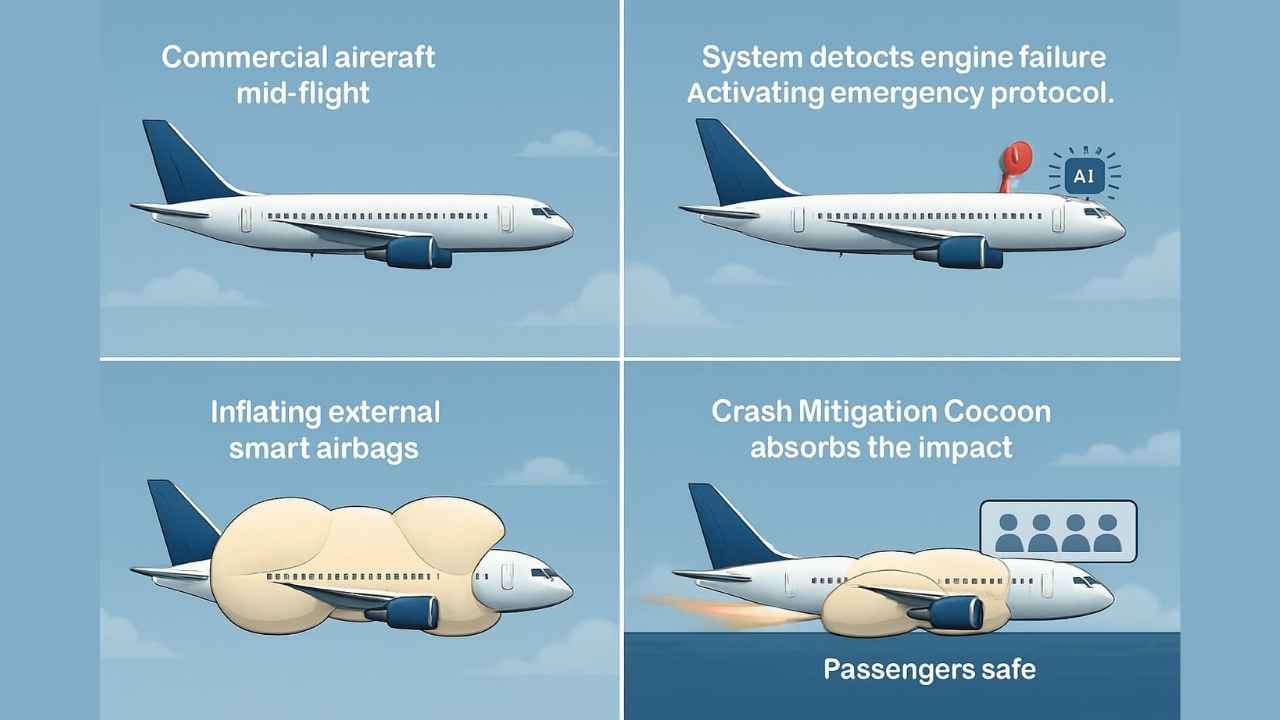
In the wake of the tragic Air India crash, which happened in June 2025 in Ahmedabad, a pair of engineers has unveiled a bold idea to keep passengers safer in the sky. Their invention? An AI-powered aircraft safety system with giant external airbags. While the idea may sound far-fetched, experts say it could save lives when seconds matter.
Credit: PROJECT REBIRTH
Project REBIRTH: AI airbags for planes
The concept, called Project REBIRTH, is one of the finalists for the James Dyson Award, which highlights groundbreaking innovations.
The inventors, Eshel Wasim and Dharsan Srinivasan of the Birla Institute of Technology and Science’s Dubai campus, wanted to give passengers a chance at survival even when things go wrong midair. They were inspired after the devastating Air India Flight 171 crash in June 2025, which killed 241 people just 30 seconds after takeoff from Ahmedabad.
Credit: PROJECT REBIRTH
How AI-powered aircraft airbags work
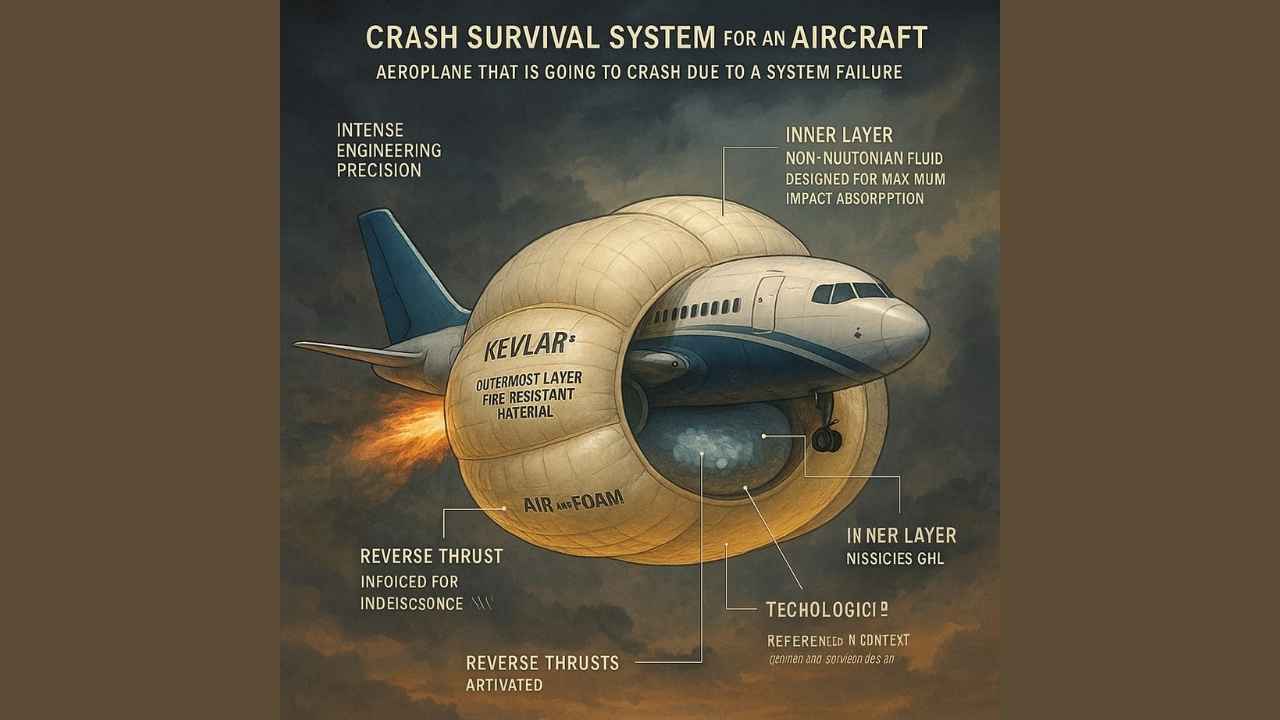
The system constantly monitors altitude, speed, engine performance, fire risk, and pilot actions. When a crash becomes imminent below 3,000 feet, the AI responds in less than two seconds. It triggers massive external airbags that wrap around the nose, tail, and belly of the plane to absorb the force of impact.
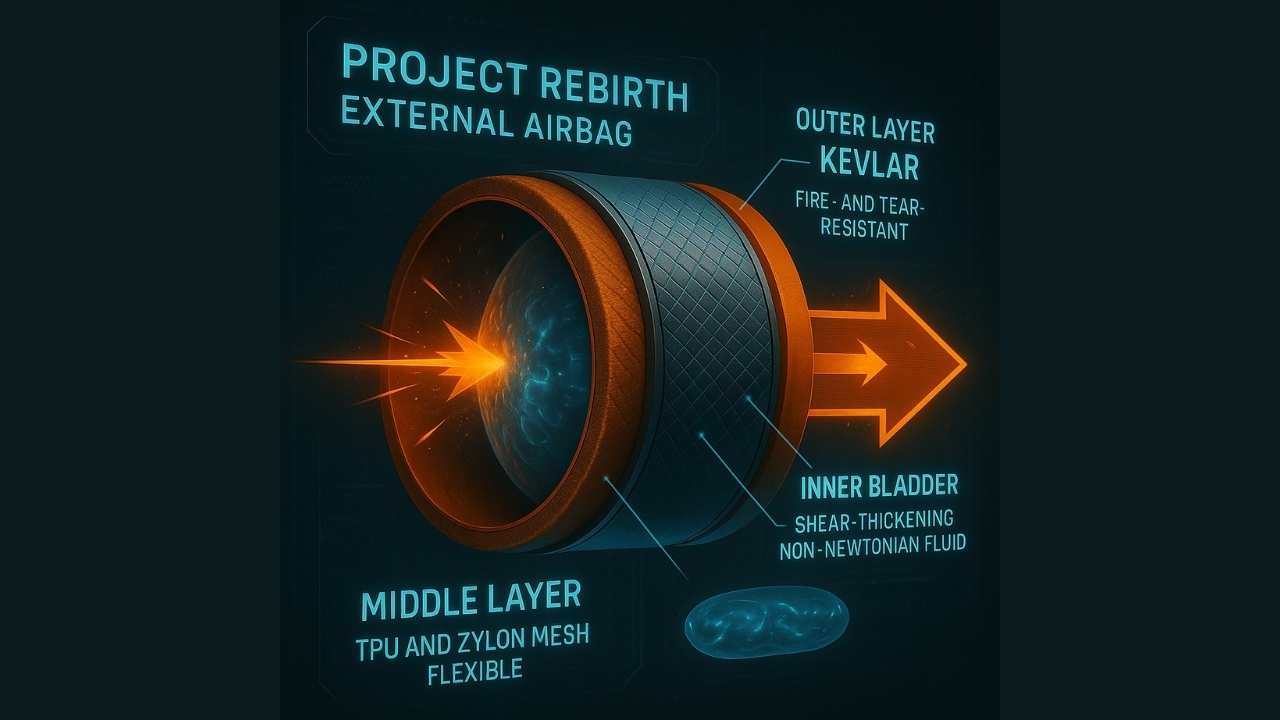
If the engines remain functional, reverse thrust kicks in to slow the descent. When engines fail, gas thrusters fire to keep the aircraft stable in the air. Inside the cabin, walls and seats hold impact-absorbing fluids that stay soft during flight but harden instantly when the plane hits the ground. This rapid transformation cushions passengers and reduces injuries.
By combining these safety layers, the system aims to change the outcome of the most dangerous crashes. What once seemed impossible, turning catastrophic accidents into survivable landings, now looks like a real possibility.
Credit: PROJECT REBIRTH
Why AI aircraft safety matters
The inventors describe their project as “a response to grief.” After the crash, they asked themselves why no system exists to improve survival chances once engines fail. Their emotional drive turned into months of research and design.
If successful, REBIRTH could be added to new planes or retrofitted into existing ones. The team hopes to begin testing with aerospace labs in the coming years.
How one convincing SSA scam nearly tricked a reader, and the five red flags to check before you click.

Join Kurt Saturday, June 13 at 10 AM ET for quick phone privacy and security fixes.
See Kurt’s 2026 picks for practical tech and everyday upgrades.
What this means for you
If Project REBIRTH becomes reality, air travel could become far safer than ever before. While air crashes are rare, knowing that an aircraft has life-saving systems on board could ease passenger fears. It also shows how AI is moving beyond convenience and into life-saving applications.
Related Links:
- First electric passenger plane lands at JFK in milestone flight
- NASA’s Martian helicopter promises unprecedented views of the Red Planet
- How to rack up points and miles for travel
Kurt’s key takeaways
Project REBIRTH may sound unusual, even cartoonish, with planes wrapped in what looks like giant popcorn. But if it can save lives in worst-case scenarios, it could transform aviation safety forever. The invention also proves that grief and tragedy can spark meaningful innovation.
Would you feel safer flying on a plane equipped with giant AI-powered airbags, or does the idea sound too risky to trust? Let us know your thoughts in the comments below.
FOR MORE OF MY TECH TIPS & SECURITY ALERTS, SUBSCRIBE TO MY FREE CYBERGUY REPORT NEWSLETTER HERE
Copyright 2025 CyberGuy.com. All rights reserved. CyberGuy.com articles and content may contain affiliate links that earn a commission when purchases are made.
🎙 Now Streaming: My New Podcast: The CyberGuy Report
Kurt’s Top Deals
Deals move fast and inventory can be limited, so don’t wait too long.
| 🔥 Editor’s pick  Summer entertaining Ninja SLUSHi Machine (26% off) Frozen drinks and slushies at home in minutes. | |
| 💰 Top deal  Outdoor essential TYPEC Solar Bug Zapper (36% off) Solar-powered bug zappers for patios and camping. |


6 comments
I am intrigued by AI Project REBIRTH. The idea of inflatable airbags wrapped around the plane to allow for a smoother landing sounds amazing.
The idea sounds great. However, it just reminds me of the Lindenberg problem when the out lying body of the plane just exploded with a fireball. That is my concern. Or if it just goes off on its own by mistake, then we have another issue. How does the pilot take control of a big bubble with popcorn device around the airplane
Project REBIRTH sounds great, even if it is expensive. However, software security related to this needs to be “firmed up”. (on a related note, I read some time ago that self-driving cars have open software and it would be relatively easy for hackers to take over driving those vehicles by using WiFi signals).
Planes aren’t built to survive crashes, they will still break apart on impact
The only way this would be conceivable to me, is if it was totally manual, and the pilot had to initiate it. I doubt that the aircraft is at all flyable if this deploys. The aircraft commander has to have sole authority.
The pilot should control it. Could this also be used if the plane is going to crash in bodies of water and keep the plane floating until rescuers arrive