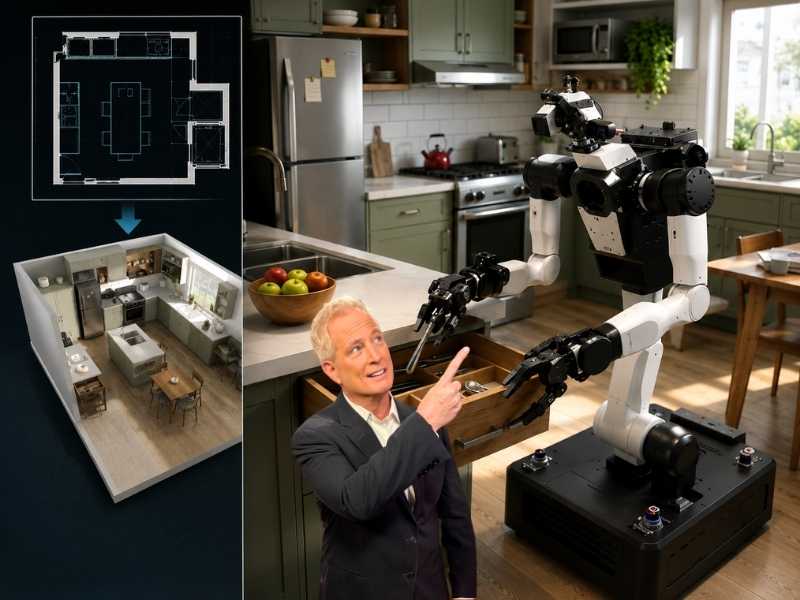



- MIT’s SceneSmith uses AI agents to build realistic 3D rooms from simple text prompts.
- Robots can practice chores and expose weak action plans before entering real homes.
- Researchers created more than 1,300 scenes with far more objects than earlier systems.
- Each detailed scene can take hours to generate, and real-world testing is still needed.
Ask a robot to put a coffee mug in the cabinet, and you quickly see how complicated an ordinary chore can become. You know where the mug belongs. You can step around a chair, avoid the clutter on the counter and open the right cabinet without giving it much thought. A robot has to work through every part of that process.
That helps explain why today’s robots can look impressive during a demonstration but still struggle with basic jobs around a home or factory. They need experience in many different rooms and situations before they can work reliably. Teaching them everything in the physical world takes time and plenty of hands-on supervision.
Researchers at MIT’s Computer Science and Artificial Intelligence Laboratory and Toyota Research Institute believe virtual training could help. Their system, called SceneSmith, uses AI agents to create detailed 3D indoor environments from simple text prompts. Robots can then practice tasks and expose weak action plans inside those AI-generated spaces before they enter a real home or workplace.
Credit: SceneSmith
Why AI virtual homes matter for robot training
Robots learn through experience. However, engineers cannot easily stage every room layout or object arrangement a machine may encounter. Physical testing also requires someone to reset the scene after each attempt. A tipped chair or misplaced bottle can change the next test. Meanwhile, a failed movement may damage the robot or something nearby.
Simulation offers a safer alternative. A robot can repeat a task without breaking a dish or tying up a real workspace. Still, many earlier simulation systems created rooms that felt sparse. They often lacked the clutter, movable furniture and physical details found in everyday spaces. SceneSmith makes those training environments feel much closer to the real world.
Other developers are also using AI video technology to speed up humanoid robot training, turning small amounts of real footage into synthetic training environments.
How SceneSmith builds AI virtual homes
SceneSmith starts with a simple written request. A researcher could ask for a garage with a car and workbench, then add tires in the corner and a ladder against the wall. From there, three AI agents powered by GPT-5.2 work together to build the space. A designer starts creating the room. A critic checks whether everything looks realistic. An orchestrator manages the back-and-forth and decides when the design is ready.
SceneSmith builds each environment one layer at a time. It starts with the floor plan and furniture, then adds objects to the walls and ceiling. Smaller items that a robot can pick up or move come last. The critic also catches choices that feel out of place. For example, it might suggest removing a bathtub from the living room. The orchestrator can even send the project back a few steps when part of the design needs more work.
Once the agents agree, SceneSmith adds the physics that control how objects move and react. The result gives researchers a working virtual room where a robot can open cabinets and handle objects instead of a 3D scene that only looks realistic.
SceneSmith creates objects robots can use
A robot needs more than realistic scenery. It needs objects that respond when touched. SceneSmith can place cabinets with working doors. It can also create movable objects and estimate physical properties such as mass or friction. Those details affect how an item reacts when a robot grabs, pushes or drops it.
For standard objects, the system can use a text-to-image-to-3D process. It retrieves articulated items with moving parts from a curated library. This approach keeps cabinet doors and drawers functional inside the simulator. The system also checks for overlapping objects and lets gravity settle them into stable positions.
Researchers reported that 96% of objects remained stable during simulation. Fewer than 2% of object pairs collided with one another. That work matters because a robot cannot learn much from a virtual kitchen where cups float or furniture sinks into the floor.
Better virtual practice could also support advances like this new AI brain that helps robots move more like humans, especially when a task requires precise hand movements.
Watch the latest episode of The CyberGuy Report.

Missed this event? Sign up via the registration form and see our live recording.
See Kurt’s latest Amazon picks for useful gadgets, smart home upgrades and everyday tech worth grabbing while the deals last.
Credit: SceneSmith
SceneSmith created more than 1,300 training spaces
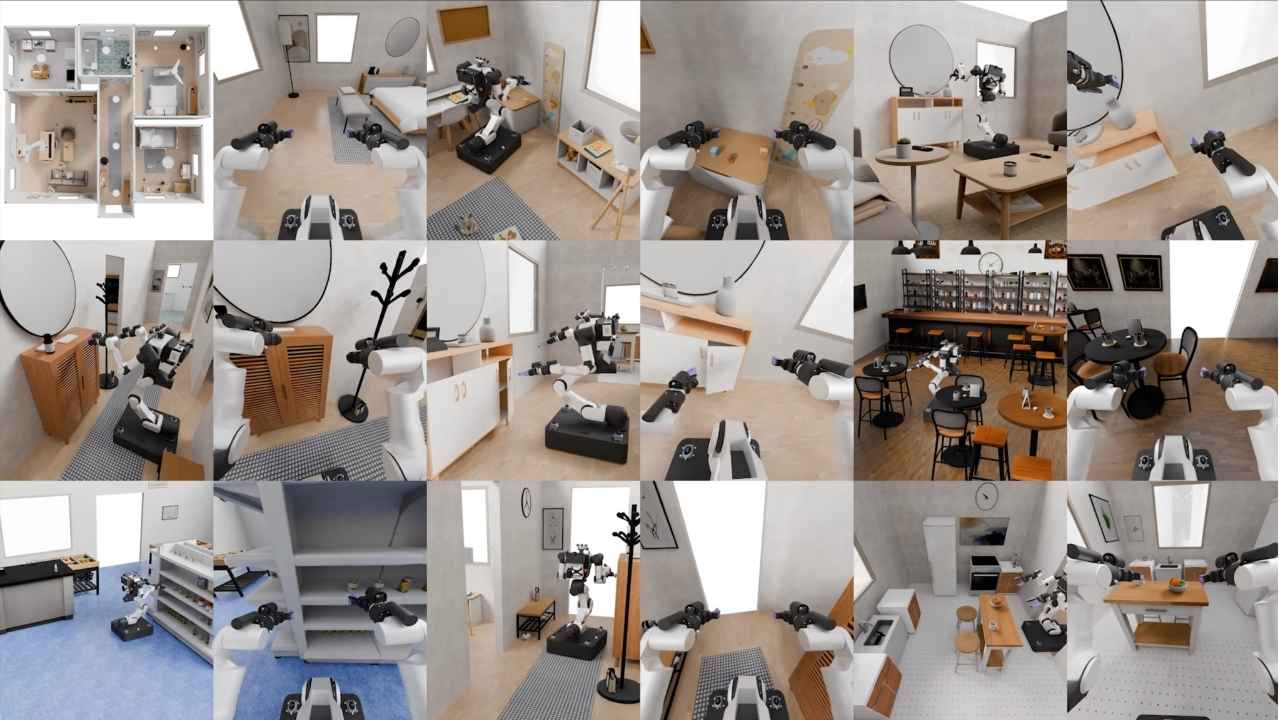
The researchers used SceneSmith to generate more than 1,300 scenes. The collection included familiar spaces such as bedrooms and hotels. It also produced unusual settings, including a pottery store and a Minecraft-themed gaming room. Some scenes contained up to six times more items than those from earlier methods. As a result, robots can encounter the type of clutter that makes real-world tasks difficult.
A robot might need to move a soda can from a shelf to a table. Another task could involve placing a cup in the sink. Each scene changes the surroundings, so the robot cannot depend on one carefully staged layout. That variety gives engineers a better way to see whether a robot’s plan works beyond a single demonstration.
AI virtual homes can expose faulty robot plans
In robotics, a policy tells a machine how to act based on what it observes. SceneSmith gives researchers a way to test those policies across many environments. The team generated 100 evaluation scenes covering four manipulation tasks. A robot policy attempted each chore in simulation. Then, an AI evaluator checked the result using simulator data and visual observations.
The evaluator reached 99.7% agreement with human labels. That result suggests researchers could use the system to screen robot attempts at scale without manually judging every run. The headline’s phrase “learn from their mistakes” needs one important distinction. SceneSmith reveals where a policy fails. Engineers can use those failures to revise later versions of the robot’s behavior. In this study, the system focused on scene generation and automatic evaluation rather than continuous self-retraining after every mistake.
Researchers tested whether the virtual homes worked
A virtual room can look realistic to a person and still behave poorly during robot training. Therefore, the team tested SceneSmith through physical interaction inside the simulator. Researchers placed an independently trained robot policy into generated scenes. The policy predated SceneSmith and had never trained on its environments or assets.
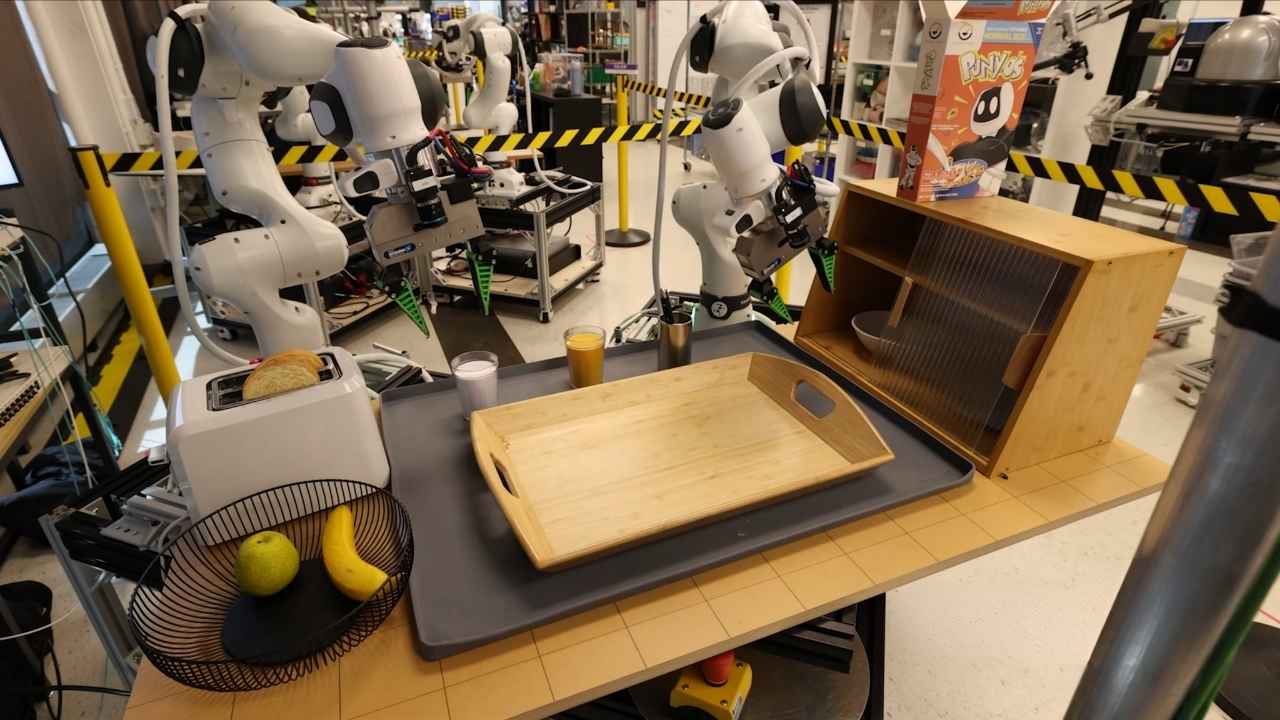
In one demonstration, the robot moved an apple from a bowl to a cutting board after receiving a language instruction. The team also teleoperated a robot through the virtual spaces. Researchers guided it as it opened cabinets and put away bottles. These tests showed that the environments could support more than visual inspection. Together, the demonstrations provide early evidence that SceneSmith’s rooms can support useful robotics experiments.

Credit: SceneSmith
People preferred SceneSmith’s virtual rooms
The researchers asked 205 people to compare SceneSmith with earlier scene-generation methods. SceneSmith recorded an average 92% win rate for realism. It also earned a 91% average win rate for following the original prompt.
In practical terms, participants usually thought its rooms looked more believable and matched the request more closely. Those results support the visual side of the system. However, robot performance remains the more important test. SceneSmith’s ability to combine realistic design with usable physics gives the project its strongest advantage.
SceneSmith still faces a major speed problem
Detailed virtual rooms take time to build. MIT says SceneSmith may need several hours to produce one scene because the AI agents create and inspect many objects. More computing power could speed up that process. Even so, generating a large training library would require substantial resources.
The current system also has limited support for deformable objects such as sponges. These materials change shape when touched, which makes them harder to reproduce in simulation. The researchers hope larger 3D libraries will help them expand that capability.
Real-world testing will still play a vital role. Homes contain unpredictable people and objects that wear down or break. Simulation can reduce risky trial and error, but engineers must still prove that robots behave safely outside a digital room.
What this means to you
A future household robot could practice inside hundreds or even thousands of virtual rooms before it ever rolls into your kitchen. That gives developers more chances to catch a bad move or weak action plan while the robot remains inside a simulator. SceneSmith can also expose a robot to rooms filled with different furniture, objects and layouts. That matters because your kitchen will look nothing like the carefully arranged space where a robot first learned a task.
That kind of preparation could eventually help machines like this home robot designed to cook, clean and organize the clutter and surprises found in everyday homes.
The technology remains in the research stage, and robots will still need plenty of testing in the physical world. Still, SceneSmith tackles a problem robot makers need to solve: How do you prepare a machine for homes where chairs move, counters get cluttered and almost nothing stays in the same place?
Related Links:
- Humanoid robots perform live surgery in world first
- A wheeled robot may beat humanoids into your home
- Humanoid robot cleans first US apartment
Kurt’s key takeaways
SceneSmith gives robots a safe place to get things wrong. Engineers can spot a bad move inside a crowded virtual home before the machine risks damaging something or moving too close to a person. What makes this system interesting is that the rooms actually work like physical spaces. Cabinets open, objects move and robots can interact with what is around them. The biggest drawback is speed. Building one detailed scene can take hours. Still, these AI-generated environments could help developers catch more problems before a robot ever enters your home.
Would you trust a household robot more if it had already made thousands of mistakes inside AI-generated homes? Let us know your thoughts in the comments below.
FOR MORE OF MY TECH TIPS & SECURITY ALERTS, SUBSCRIBE TO MY FREE CYBERGUY REPORT NEWSLETTER HERE
Copyright 2026 CyberGuy.com. All rights reserved. CyberGuy.com articles and content may contain affiliate links that earn a commission when purchases are made.
🎙 Now Streaming: My New Podcast: The CyberGuy Report
Kurt’s Top Deals
Deals move fast and inventory can be limited, so don’t wait too long.
| 🔥 Editor’s pick  Summer entertaining Ninja SLUSHi Machine (26% off) Frozen drinks and slushies at home in minutes. | |
| 💰 Top deal  Outdoor essential TYPEC Solar Bug Zapper (36% off) Solar-powered bug zappers for patios and camping. |