



Noninvasive brain tech is transforming how people interact with robotic devices. Instead of relying on muscle movement, this technology allows a person to control a robotic hand by simply thinking about moving their fingers. No surgery is required. Instead, a set of sensors is placed on the scalp to detect brain signals. These signals are then sent to a computer. As a result, this approach is safe and accessible. It opens new possibilities for people with motor impairments or those recovering from injuries.
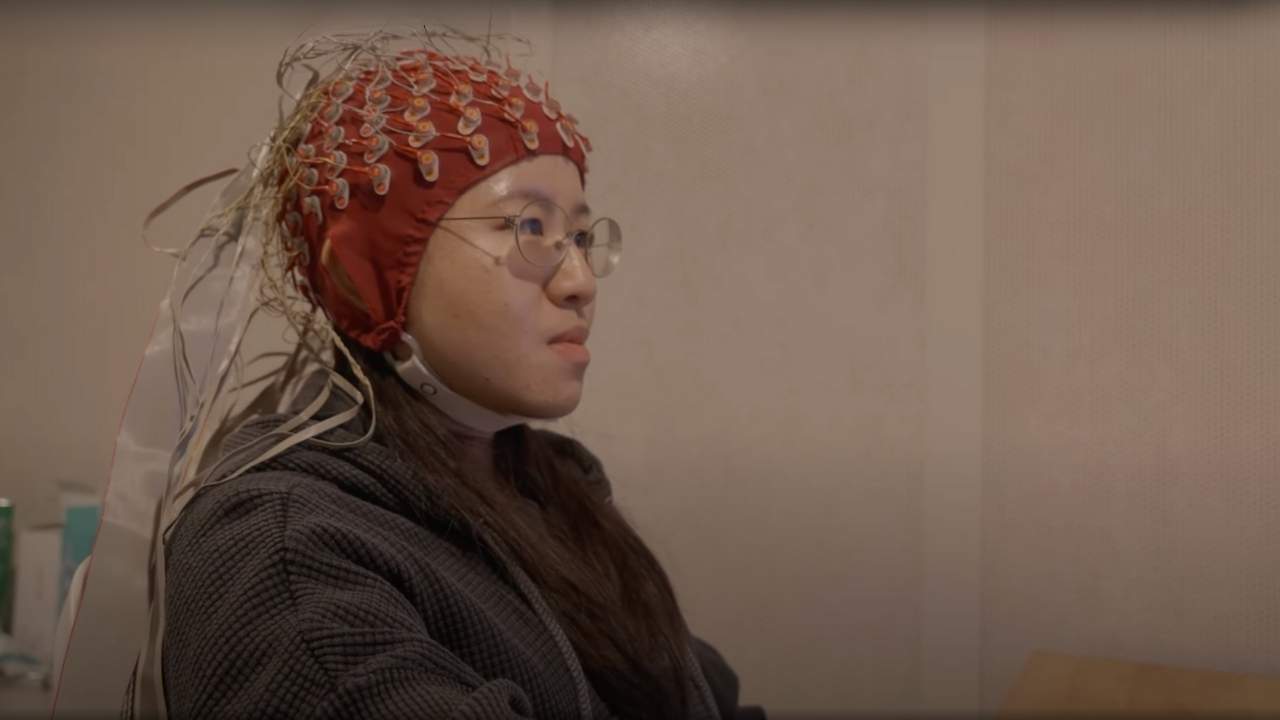
Credit: Carnegie Mellon University
How noninvasive brain tech turns thought into action
Researchers at Carnegie Mellon University have made significant progress with noninvasive brain technology. They use electroencephalography (EEG) to detect the brain’s electrical activity when someone thinks about moving a finger. Artificial intelligence, specifically deep learning algorithms, then decodes these signals and translates them into commands for a robotic hand. In their study, participants managed to move two or even three robotic fingers at once, just by imagining the motion. The system achieved over 80 percent accuracy for two-finger tasks. For three-finger tasks, accuracy was over 60 percent. All of this happened in real time.
Meeting the challenge of finger-level control
Achieving separate movement for each robotic finger is a real challenge. The brain areas responsible for finger movement are small. Their signals often overlap, which makes it hard to distinguish between them. However, advances in noninvasive brain tech and deep learning have made it possible to pick up on these subtle differences. The research team used a neural network called EEGNet. They fine-tuned it for each participant. Because of this, the system allowed for smooth, natural control of the robotic fingers. The movements closely matched how a real hand works.

Credit: Carnegie Mellon University
Why noninvasive brain tech matters for everyday life
For people with limited hand function, even small improvements can make a huge difference. Noninvasive brain tech eliminates the need for surgery because the system is external and easy to use. In addition, this technology provides natural and intuitive control. It enables a person to move a robotic hand by simply thinking about the corresponding finger movements. The accessibility of non-invasive brain technology means it can be used in clinics, homes, and by a wide range of people. For example, it enables participation in everyday tasks, such as typing or picking up small objects, that might otherwise be difficult or impossible to perform. This approach can benefit stroke survivors and people with spinal cord injuries. It can also help anyone interested in enhancing their abilities.
What’s next for noninvasive brain tech?
While the progress is exciting, there are still challenges ahead. Noninvasive brain technology needs to improve even further at filtering out noise and adapting to individual differences. However, with ongoing advances in deep learning and sensor technology, these systems are becoming more reliable and easier to use. Researchers are already working to expand the technology for more complex tasks. As a result, assistive robotics could soon become a part of more homes and workplaces.

Credit: Carnegie Mellon University
Related Links:
- Brain implant enables ALS patient to communicate using AI
- AI brain scan tool predicts how fast you are aging
- AI and learning retention: Does ChatGPT help or hurt?
Kurt’s key takeaways
Noninvasive brain tech is opening up possibilities that once seemed out of reach. The idea of moving a robotic hand just by thinking about it could make daily life easier and more independent for many people. As researchers continue to improve these systems, it will be interesting to see how this technology shapes the way we interact with the world around us.
If you had the chance to control a robotic hand with your thoughts, what would you want to try first? Let us know in the comments below.
FOR MORE OF MY TECH TIPS & SECURITY ALERTS, SUBSCRIBE TO MY FREE CYBERGUY REPORT NEWSLETTER HERE
Watch the latest episode of The CyberGuy Report.

Missed this event? Sign up via the registration form and see our live recording.
See Kurt’s Prime Day picks for useful gadgets, practical upgrades and everyday tech while the deals last.
🎙 Now Streaming: My New Podcast: The CyberGuy Report
Kurt’s Top Deals
Deals move fast and inventory can be limited, so don’t wait too long.
| 🔥 Editor’s pick  Summer entertaining Ninja SLUSHi Machine (26% off) Frozen drinks and slushies at home in minutes. | |
| 💰 Top deal  Outdoor essential TYPEC Solar Bug Zapper (36% off) Solar-powered bug zappers for patios and camping. |


1 comment
There is no interface between sentient human energy consciousness and machine, a device that requires continuous outside electrical source. Without electricity, AI is a heavy paperweight. You must understand that information and knowledge cannot and does not exist apart from the human personality or personalities that knows it. A.I. makes full use of human intelligence programmed into its algorithms, memory banks, and the lightening fast speeds makes it quite desirable for many applications beyond human brain speed. A.I. has tremendous advantages, but it is limited by the degree of human intelligence programmed into it. Understand, also, that there is information beyond your capacity to understand at your present level of development, due to the limiting factors of your physical senses, your neurological, biological, physiological and psychological structure. When early computers came out, the G.I.G.O. principal was associated with computer information. That is, garbage in, garbage out, and the same principal applies to A.I., many decades later. A.I. cannot be programmed with information human intelligence does not as yet know or is aware of. However, you are not aware of intelligence beyond your world, again, due to the limiting factors of your physical sense data. For example, if Nazi Germany and communist Russia, and religious Iran, had their own ultra-super A.I. computers, what people would get out of them is their propaganda programmed into it, you see. The ancient adage, you reap what you sow applies today as much as it did centuries ago. Cast in modern terms, “You create your own reality according to your beliefs, intents, attitudes and expectations, and you do so individually, and collectively all together, en masse. Now where did I get my information given here? I have a viable source, but it is best that I keep you guessing. Thanks, R. H. C., DOB, 11/07/1944.