



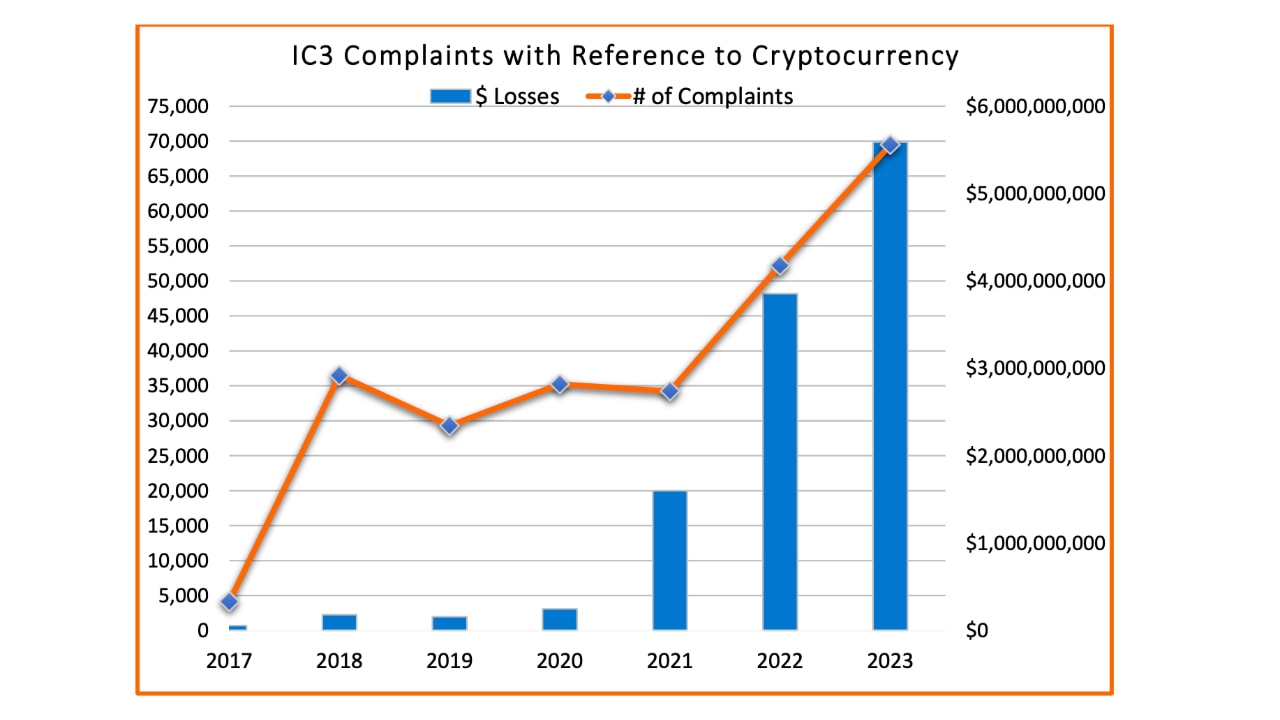
Cryptocurrency was supposed to change the way we handle money. We kept hearing from influencers and ‘experts’ about how it would give you full control of your cash and how secure it is. But scammers have shown that crypto isn’t as foolproof as promised—it’s actually pretty easy to steal. The FBI reported Americans lost $5.6 billion to crypto scams in 2023, a 45% jump from the year before. Over 69,000 people filed complaints with the Feds’ Internet Crime Complaint Center (IC3) last year, and most of them were aged 60 and up.
The most common crypto scams
The FBI’s IC3 report highlighted various crypto scams, most of which involve strong social engineering tactics.
Investment fraud
First off, we have investment fraud. Scammers contact you via call, text, or email, promising huge (unheard of) profits if you invest in cryptocurrency. They tell you that everyone is investing and making massive returns, and if you don’t, you will miss out. This usually works on people who are eager to invest but aren’t sure how to get started—in other words, those who have the cash to invest but aren’t very tech-savvy. Losses from investment fraud schemes reported to the IC3 rose from $2.57 billion in 2022 to $3.96 billion in 2023, an increase of 53%.
Relationship building scams
Scammers sometimes build a relationship with you to make the scam seem legit. They use dating apps, social media, professional networking sites, or encrypted messaging apps to get close to their targets. Once they’ve gained your trust, they bring up cryptocurrency investment. They might claim they have some expertise or know an expert who can help you make big money. Then, they push you to use fake websites or apps—ones they control—to invest in crypto. To make things even worse, scammers sometimes go after the same people again by pretending to be fake crypto-recovery specialists. They promise to help recover the money the original scammers stole but end up taking even more cash and disappearing with that, too. “There is one thing these scammers typically will not do – they will not meet with you in real life,” the feds said.
IC3
HOW TO AVOID BECOMING A MOVING SCAM VICTIM
Scammers are targeting elderly folks
Crypto scammers are primarily targeting people over 60, especially those who aren’t very familiar with technology. According to the Feds, most of the complaints they received in 2023—about 16,806—came from this age group. In total, they lost over $1.6 billion to these scams. Looking at complaints across all age groups, it’s clear the losses are staggering. Here’s a breakdown of the 2023 complaints and losses by age group:
- Under 20: 858 complaints, $14.7 million in losses
- 20-29: 6,258 complaints, $168.6 million in losses
- 30-39: 10,849 complaints, $693.7 million in losses
- 40-49: 10,318 complaints, $843.9 million in losses
- 50-59: 8,918 complaints, $901.1 million in losses
- Over 60: 16,806 complaints, $1.65 billion in losses
“While individuals in the age ranges of 30 – 39 and 40 – 49 filed the most cryptocurrency-investment fraud complaints (approximately 5,200 reports in each age group), complainants over the age of 60 reported the highest losses (over $1.24 billion)”, noted the FBI report.

DON’T FALL PREY TO THIS ELECTION SEASON’S CRAFTIEST SCAMS
What you need to know before getting yourself into crypto
There’s a lot about crypto and crypto scams that we don’t know, so to gain some expert insights, I asked Paige Schaffer, CEO of Iris Powered by Generali, provider of a proprietary identity and cyber protection platform, some questions that many of us have in mind.
1) What steps should someone take if they suspect they’ve fallen victim to a cryptocurrency scam?
Watch the latest episode of The CyberGuy Report.

Missed this event? Sign up via the registration form and see our live recording.
See Kurt’s latest Amazon picks for useful gadgets, smart home upgrades and everyday tech worth grabbing while the deals last.
If you suspect that you’ve fallen victim to a cryptocurrency scam, it’s crucial to act quickly to mitigate potential losses. First, immediately stop all transactions with the suspected scammer – this includes halting any ongoing investments, withdrawals, or deposits to prevent further loss. Next, change your passwords and enable two-factor authentication on all your related accounts if you haven’t done so already. This includes your email and any other linked financial accounts.
Also, consider using a password manager to securely store and generate and complex passwords. It will help you to create unique and difficult-to-crack passwords that a hacker could never guess. Second, it also keeps track of all your passwords in one place and fills passwords in for you when you’re logging into an account so that you never have to remember them yourself. The fewer passwords you remember, the less likely you will be to reuse them for your accounts.
- Unlimited password storage
- Secure sharing
- Password health reports
- Auto-fill and emergency access
- Data breach monitoring to alert you if your credentials have been exposed
- A Security Dashboard with tools like the Data Breach Scanner and Password Health Checker to identify weak, reused, or compromised passwords
CyberGuy Exclusive Deal: Save 52% now with CyberGuy’s exclusive NordPass offer – Get 1 extra month FREE with a 2-year plan. Try 30 days risk-free for only $1.43 per month!
2) How can individuals verify the legitimacy of a cryptocurrency exchange or platform before investing?
Before you invest in crypto, search online for the name of the company or person and the cryptocurrency name, plus words like “review,” “scam,” or “complaint.” See what others are saying. You can also check for any news articles about the exchange. Positive news about partnerships or technological advancements can be a good sign, whereas reports of security breaches or legal issues are red flags.
Popular exchanges like Binance, Coinbase, and Kraken have a history of security and transparency, unlike many smaller, lesser-known platforms that could be fraudulent or easily hacked.
3) Are there any specific security measures people should implement to protect their digital wallets and cryptocurrency assets?
Strong, unique passwords and two-factor authentication are a must for digital wallets and crypto assets. We also recommend hardware wallets for storing large amounts of crypto assets, as these are not connected to the internet and provide superior protection against hacking. It’s important to regularly update wallet software to ensure
vulnerabilities are patched.
4) What advice would you give to someone who’s interested in investing in cryptocurrency but is concerned about potential scams?
It’s wise to be concerned about scams in the crypto universe, so you’re already on the right track! Keep this mindset but know that there is a safe way to invest in cryptocurrency. Start by first investing time in researching and understanding different cryptocurrencies, including their market trends, technological foundations, and community and developer activities. Only use reputable exchanges and wallets which adhere to regulatory standards and offer robust security measures.
HOW SCAMMERS ARE USING YOUR PERSONAL DATA FOR FINANCIAL SCAMS AND HOW TO STOP THEM
5 other important ways to protect yourself from crypto scams
1) Be skeptical of “too good to be true” offers: One of the biggest red flags in crypto scams is the promise of guaranteed, massive returns with little or no risk. Scammers will often entice people with claims of doubling or tripling their investments in a short period. Always approach these offers cautiously, as legitimate investments don’t guarantee profits.
2) Avoid sharing personal information: Your personal information is your gateway to your crypto funds, and scammers often try to trick people into sharing sensitive details like private keys, passwords, or wallet information. Never share this data with anyone, even if they claim to be from a legitimate company or exchange. Be especially cautious of phishing emails or fake customer service representatives asking for your details—reputable companies will never ask for this kind of information.
3) Have strong antivirus software installed on all of your devices: The best way to safeguard yourself from malicious links that install malware, potentially accessing your private information, is to have antivirus software installed on all your devices. This protection can also alert you to phishing emails and ransomware scams, keeping your personal information and digital assets safe.
- Strong real-time protection against viruses, malware, ransomware and hacking attempts
- AI-powered scam protection to help identify suspicious emails, texts and websites
- Built-in password manager to securely store and manage logins
- 2 GB PC cloud backup to help protect important files from ransomware or hardware failure
- Smart firewall and phishing protection
- Protects 1, 3 or 5 devices
- Available for Windows, macOS, Android and iOS
- Includes real-time threat protection, smart firewall and phishing protection to guard against online attacks
4) Watch out for unsolicited contacts: Scammers often reach out to potential victims through social media, dating apps, professional networking platforms, or even email, pretending to be friends, financial advisors, or crypto experts. If someone you don’t know offers an investment opportunity, claims to have inside knowledge, or urges you to act quickly, it’s a major red flag.
5) Remove your personal information from the internet – Getting your personal information off the web is key to stopping scammers from contacting you in the first place. With Incogni, you can remove your data from databases and websites that expose it to cybercriminals. By taking this step, you reduce the risk of being targeted by scammers who might otherwise use your info to trick you into downloading malware or giving up passwords to your personal accounts. Incogni helps you stay protected by keeping your private information out of scammers’ reach
Incogni, a service I trust 100% and use myself, helps automate the process by submitting removal requests to hundreds of data brokers and people-search sites on your behalf. Incogni automatically contacts data brokers on your behalf and requests the removal of your personal information. It also continues monitoring those sites and submits new removal requests if your data reappears. CyberGuy readers get 60% off Incogni’s annual plans using the links in this article. The service also includes a 30-day money-back guarantee, so you can try it risk-free and see how much of your information is exposed online.
BEWARE OF ENCRYPTED PDFS AS THE LATEST TRICK TO DELIVER MALWARE TO YOU
Kurt’s key takeaway
While cryptocurrency might seem like a great way to make money, it’s full of risks, and I’d say steer clear unless you’re really tech-savvy. I’m not against the technology itself—it does have the potential to deliver on all the promises. However, since crypto cuts out intermediaries like banks, it also opens the door for criminals to take advantage of it for things like theft, fraud, and money laundering.
Do you feel confident about your understanding of how cryptocurrency works, or does it still seem confusing? Let us know in the comments below.
FOR MORE OF MY TECH TIPS & SECURITY ALERTS, SUBSCRIBE TO MY FREE CYBERGUY REPORT NEWSLETTER HERE
Copyright 2024 CyberGuy.com. All rights reserved. CyberGuy.com articles and content may contain affiliate links that earn a commission when purchases are made.
🎙 Now Streaming: My New Podcast: The CyberGuy Report
Kurt’s Top Deals
Deals move fast and inventory can be limited, so don’t wait too long.
| 🔥 Editor’s pick  Summer entertaining Ninja SLUSHi Machine (26% off) Frozen drinks and slushies at home in minutes. | |
| 💰 Top deal  Outdoor essential TYPEC Solar Bug Zapper (36% off) Solar-powered bug zappers for patios and camping. |